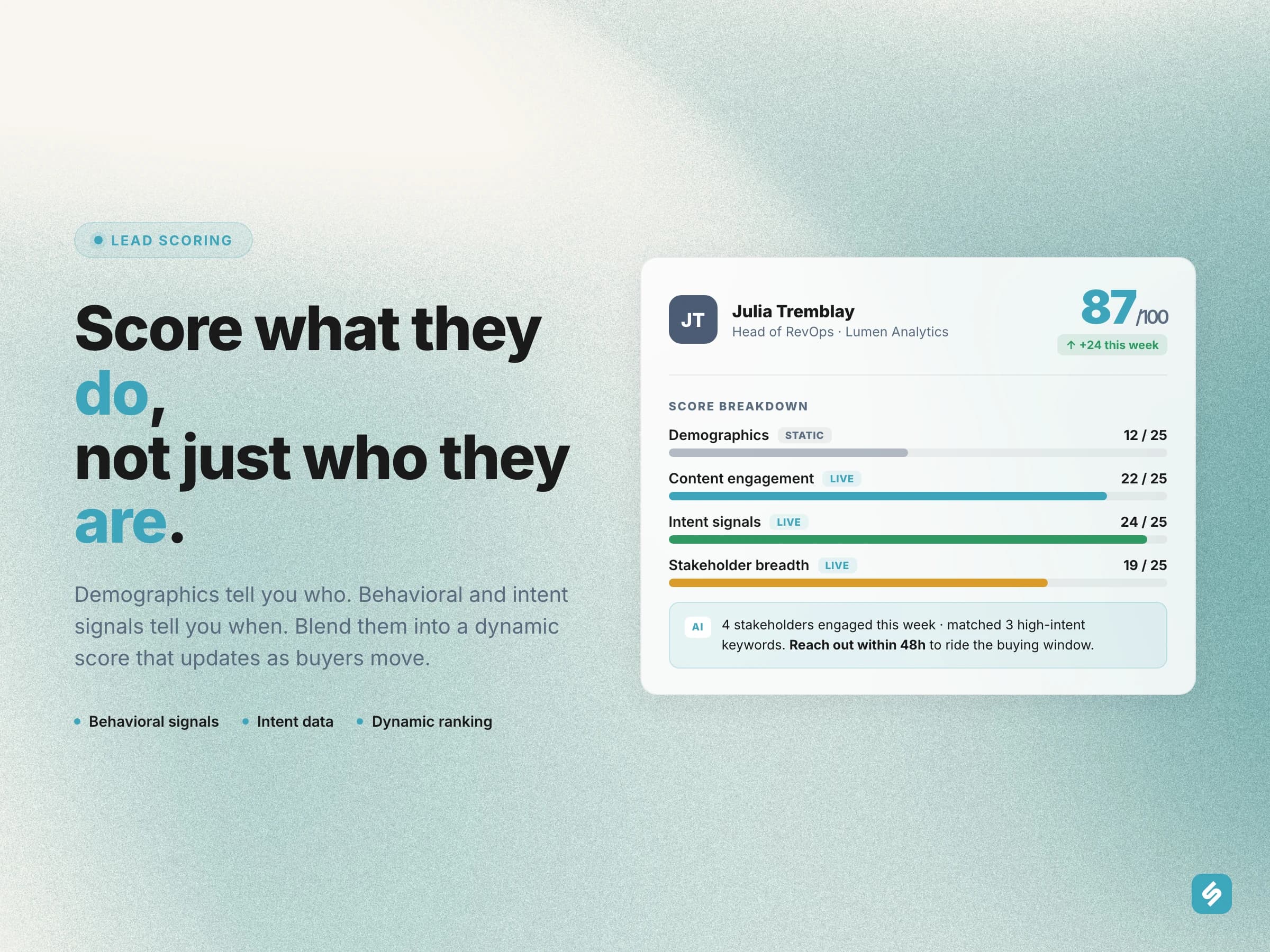
Advanced lead scoring is the natural complement to a B2B LinkedIn social listening tool: once you can detect intent signals at scale, you need a scoring model that ranks them. This page covers how to move beyond static demographics and use behavioral signals to score leads dynamically.
The limitations of traditional scoring
Most B2B companies still rely on demographic-based lead scoring. Company size, industry, job title - these static attributes form the foundation of most scoring models. But demographics only tell part of the story.
A CEO at a 500-person SaaS company might score highly on paper, but if they're not actively researching solutions in your category, they're not a priority. Meanwhile, a mid-level manager at a smaller company who's been consuming content about your solution area might be ready to buy.
Behavioral signals change the game
Modern lead scoring incorporates behavioral signals to create a more complete picture, though not every signal deserves a score, our typology of which signals are noise separates the predictive ones from the distractions:
Content Engagement Patterns
- Which content pieces are they consuming?
- How much time are they spending on key pages?
- Are they sharing or discussing your content internally?
Research Behavior
- What solutions are they actively researching?
- Are they comparing vendors in your category?
- How urgent does their timeline appear?
Stakeholder Involvement
- How many people from their organization are engaging?
- Are decision-makers included in the research process?
- What's the engagement pattern across different roles?
Intent data: The missing piece
Intent data reveals when prospects are actively researching solutions. This includes:
- Search behavior: what keywords are they using? (See our LinkedIn intent data tool for the public-post angle.)
- Content consumption: which vendor comparisons are they reading?
- Technology research: what tools are they evaluating?
- Career moves: job changes often reset buying priorities within the first 90 days.
When combined with behavioral signals, intent data creates a powerful scoring foundation that updates in real-time based on actual buyer behavior.
Building dynamic scoring models
Static scoring models become outdated quickly. Dynamic models adjust based on:
- Recency: Recent activities carry more weight
- Frequency: Repeated engagement indicates higher interest
- Depth: Time spent and pages visited show engagement quality
- Breadth: Multiple stakeholders suggest organizational interest
Implementation best practices
Start with your current data
Don't wait for perfect data to begin. Enhance your existing demographic scoring with whatever behavioral data you have access to.
Focus on outcomes
Optimize your scoring model based on actual conversions, not vanity metrics like email opens or page views.
Regular model updates
Review and adjust your scoring criteria quarterly based on performance data and changing buyer behavior.
The future of lead scoring
As buyer behavior continues to evolve, lead scoring must become more sophisticated. We're moving toward AI-powered models that can:
- Identify subtle behavioral patterns humans might miss
- Predict optimal outreach timing
- Suggest personalized messaging based on engagement history
- Continuously optimize based on outcomes
The companies that master advanced lead scoring will have a significant advantage in an increasingly competitive B2B landscape.
Getting started
- Audit your current model: What data are you using? What are you missing?
- Identify behavioral signals: What actions indicate buying intent in your market?
- Implement tracking: Ensure you're capturing the right behavioral data
- Test and iterate: Continuously improve based on actual results
Lead scoring isn't a set-it-and-forget-it system. It's a dynamic capability that requires ongoing attention and optimization. But for teams willing to invest in advanced scoring, the payoff in sales efficiency and revenue impact can be substantial.
Related plays
- B2B LinkedIn competitor monitoring tool, feed your scoring model with competitor engagement signals.
- Turn competitor activity into pipeline, the tactical play.
- B2B champion tracking software, re-score warm contacts the moment they move.