A B2B champion tracking software does one thing extremely well: it tells your team the moment a former customer, someone who already knows and trusts your product, lands a new role inside an ICP-matching company. That moment opens a 30-to-90-day window where outbound converts five to ten times higher than any cold sequence. This page covers what champion tracking actually is, why it is the highest-ROI buying signal in B2B, how to set one up in under five minutes, and how to combine it with the other signals in your stack. This page sits inside our broader playbook on how signal intelligence is changing prospecting.
What is B2B champion tracking software?
Champion tracking software continuously monitors a defined list of contacts, your champions: past customers, power users, executive sponsors, internal advocates, and surfaces the moment any of them changes companies. The valuable signal is not the move itself. It is the combination of three facts arriving on a sales rep's desk at the same time:
- Someone who already trusts your product has moved.
- They have landed at a company that matches your ICP.
- They are inside the 30-to-90-day window where new decision-makers have fresh budget and the mandate to rebuild the stack.
Generic CRM data tells you none of this in real time. A LinkedIn audit run once a quarter tells you part of it, far too late. A B2B champion tracking software does it continuously, qualifies each match against your ICP automatically, and routes the alert into the rep's working environment (Slack, Salesforce, HubSpot) the same day the signal appears.
"We had no idea our last three enterprise expansions all started with a past champion landing somewhere new. Once we instrumented the list, the same play repeated every quarter.", anonymous Sillage customer, B2B SaaS, 300 employees

Past champion landed at an ICP account
Sarah Martin from Doctolib engaged with your competitor on LinkedIn
Why champion tracking is the highest-ROI signal in B2B
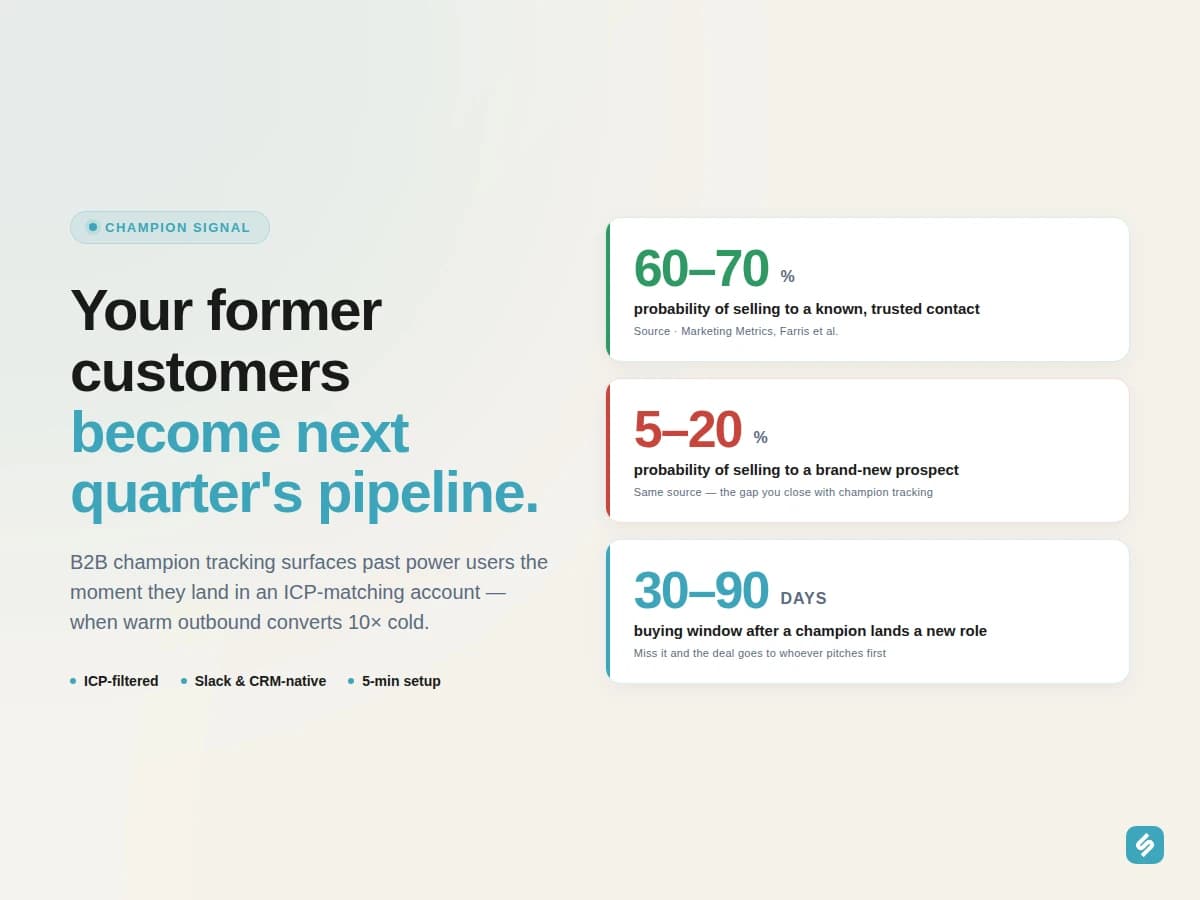
Selling to a contact who already knows your product is fundamentally different from cold prospecting. The reference book Marketing Metrics (Farris et al.) reports that the probability of selling to an existing or trusted contact sits at 60–70 %, against 5–20 % for a net-new prospect. Every other buying signal stacks on top of cold-ish data. Champion tracking compounds against an existing trust relationship.
Three concrete reasons it outperforms every other signal in pipeline economics:
- Zero re-education cost. The champion has already lived the onboarding, knows the ROI, has the internal vocabulary. The first call collapses to a 15-minute reframe instead of a 45-minute discovery.
- Internal advocacy at day one. Even before the contract, a champion in a new role brings credibility your AE cannot manufacture. They explain your product to the new buying committee in their own words.
- Compounding tenure dynamics. Average B2B decision-maker tenure has dropped below three years. Every former customer becomes a potential new account every two to three years, without any cold acquisition cost.
For the broader signal-stack framework that includes champion tracking, see how signal intelligence is changing prospecting.
How champion tracking software actually works
Three layers separate a tool that genuinely moves pipeline from one that just emails you noisy LinkedIn updates.
Layer 1, Continuous monitoring of the champion list
The system continuously watches a curated set of LinkedIn profiles and CRM contacts for role transitions. Polling has to be real-time or near real-time. A weekly CRM data sync misses the first 30 days of a 90-day window, half the opportunity gone.
Layer 2, ICP qualification before the alert reaches the rep
A raw "champion changed jobs" notification without context is operational debt for the rep. The signal must be cross-checked against the Ideal Customer Profile (industry, company size, geography, role seniority, vertical-specific criteria) before any human is paged. Non-matching events are dropped silently. The result is what AEs call a "boring inbox", 5-15 high-conviction alerts per rep per day, each with a clear next action.
Layer 3, Routing and CRM enrichment
The alert lands in the rep's working environment, not a separate dashboard. Slack + Salesforce/HubSpot natively, with the contact's full history attached: past deal stages, last touchpoint, the original product usage, and a suggested outreach angle. The rep crafts a relevant message in under three minutes, not "congrats on the new role" but "saw you just joined Doctolib as VP RevOps, when we worked together at DataFlow, you mentioned scaling outbound was your blocker; here is how we'd think about the same play at your new scale."
Three patterns of champion signals that turn into pipeline
Not every job change deserves a same-day call. After thousands of routed alerts, three patterns consistently convert.
Pattern 1, Champion moves to a higher-tier account
A former CSM at a 200-employee company joins a 5 000-employee enterprise as VP Operations. Same champion, larger budget, harder-to-crack account suddenly opened from the inside. This is the highest-value champion pattern by far.
Pattern 2, Champion moves into a buying role
A former engineer who liked your product joins a new company as Director of Engineering or CTO. The first time around they were a user; this time they are the decision-maker. Move quickly, they have weeks to shape the stack.
Pattern 3, Multiple champions converge in the same account
Two or three former customers landing at the same target account inside a 6-month window is an exceptionally strong signal. It usually means the new company is recruiting from your existing customer base, your product category is on their radar.
When champion signals are stacked with competitor activity on the same account, or with a public keyword post detected on LinkedIn, you have a triple-stacked signal that justifies same-day outreach.
| Pattern | Trigger | Buying window | Best follow-up angle |
|---|---|---|---|
| Tier-up move | Champion joins a larger / more strategic account | 30–90 days | Reference the prior success + scale it to the new headcount. |
| Buyer-role move | Former user becomes a decision-maker (Director / VP / CTO) | 30–60 days | Position as the easy default during the stack-rebuild phase. |
| Multi-champion convergence | 2+ former customers land at the same account in < 6 months | 60–120 days | Frame the play with the new exec team, category is already on their radar. |
For a complete tactical play on the most common pattern, see how to turn past champions' job changes into pipeline, same setup, end-to-end outreach scripts included.
The workflow, from alumni move to qualified meeting
A working champion-tracking-to-meeting motion has five steps. None require the rep to leave Slack or the CRM.
- Upload the champion list. Past customers, power users, executive sponsors, key stakeholders, typically 50 to 500 names to start. CSV upload, CRM sync, or manual LinkedIn URLs.
- Define ICP filters. Industry, company size, geography, seniority, plus any custom criteria your RevOps team needs. This gate removes 90 % of irrelevant matches before they reach a human.
- Configure routing. Dedicated Slack channel, CRM task on the account owner, or a hybrid for tiered accounts.
- Receive enriched alerts. Each alert includes the contact's historical relationship with your company, new role, account fit, suggested outreach angle.
- Engage warm. The rep references the shared history explicitly. Reply rates typically run 3-5x higher than the team's cold baseline.
The end-to-end cycle from public job change to outbound message runs in well under two hours when the system is configured properly. Compared to manual quarterly LinkedIn audits, it's a 10x compression.
Combining champion tracking with the rest of the Sillage stack
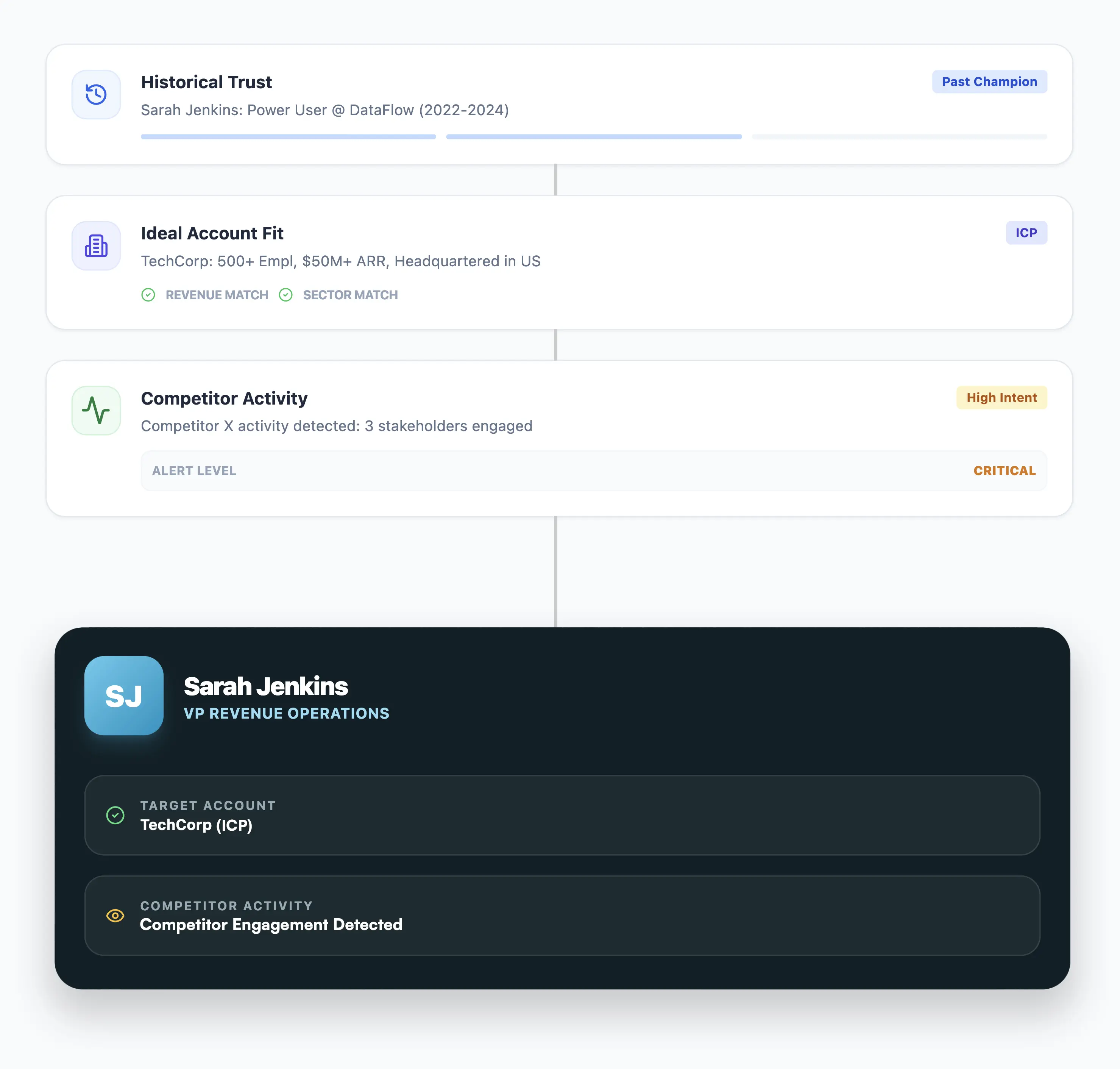
A champion engagement is most valuable when it stacks with other buying signals on the same account. Sillage cross-references the Champion Tracking agent with seven other agents.
| Agent | What it adds to a champion tracking alert |
|---|---|
| Job Updates Detection | The broader category of role transitions across your CRM and target universe |
| Competitor's Activity | A rival rep is already working the account your champion just joined |
| Content Engagement | The champion engages with category content soon after the move = active research |
| Keyword Detection | The champion publicly posts about a pain you solve in the first 30 days |
| Influencer Engagement | The champion follows a KOL in your category, vendor evaluation underway |
| Hiring Signals | The new company is hiring roles tied to your product category |
For the broader job-change signal beyond named champions, see real-time job change alerts software. For the lead-scoring layer that ranks every champion signal, see behavioral lead scoring.
What Sillage does specifically for champion tracking
Three things separate a B2B-native champion tracker from a generic CRM enrichment tool:
- Personas at the source. Sillage filters every detected move against your ICP before generating any alert. No noise, no manual triage.
- No new tool, no new tab. Alerts land in Slack and your CRM directly, where reps already work. Standalone champion dashboards die at renewal because nobody opens them.
- Cross-signal correlation. A standalone job change is interesting. A champion job change + competitor's rep engaging the same account + a keyword post about your category = a tier-1 deal forming in front of you. Sillage stacks these signals automatically across all eight signal agents.
If you are evaluating Sillage against the broader market, our roundup of the best AI tools for B2B prospecting covers the main alternatives.
Frequently asked questions
What is B2B champion tracking software?
B2B champion tracking software continuously monitors a defined list of contacts, typically past customers, power users, executive sponsors, and notifies your sales team the moment any of them changes companies. The best tools combine real-time detection with ICP qualification and CRM enrichment so every alert is actionable, not just informational.
How is champion tracking different from job change alerts?
A job change alerts software monitors any contact in your universe, known or unknown. Champion tracking is the more focused variant: it only watches the high-trust subset (former customers, internal advocates) and treats their moves as the highest-priority signal of the stack.
Who should be on the champion list?
Start with three categories: past customers who deployed your product (especially the power users), executive sponsors of past deals (the people who said yes to the budget), and current users who have moved internally. Cap the initial list at 50-100 names so signal quality stays high. You can always expand.
Does Sillage integrate with Salesforce and HubSpot?
Yes. Champion tracking signals are enriched with CRM context (deal stage, last touchpoint, account owner, prior relationship history) and routed as Slack alerts and CRM tasks natively. No Zapier or middleware required.
How is ICP filtering applied to champion moves?
Personas defined inside Sillage (role, seniority, company size, industry, geography) act as a gate on every detected move. A champion landing at a company that does not match your ICP is parked silently, no alert generated. Your reps only see the moves that are commercially worth a call.
How long does setup take?
About five minutes for the first Champion Tracking agent: connect the CRM, upload the champion list (CSV or LinkedIn URLs), define the ICP, choose the Slack channel. No engineering involvement required.
Can champion signals feed an AI agent or custom workflow?
Yes. Beyond Slack and CRM distribution, Sillage exposes a Signal API. Custom AI agents, internal scoring models, and downstream orchestration tools can consume the structured signal feed directly, the same source of truth for humans and machines.
Ready to turn your past customers into your next quarter's pipeline? Book a demo and see Sillage's Champion Tracking agent inside Slack and your CRM.
Book a demo
Related plays
Champion tracking is one of eight signal agents in the Sillage stack. Most teams stack it with:
- Real-time job change alerts software, broader monitoring beyond named champions.
- B2B LinkedIn competitor monitoring tool, see which rival reps are already on the account.
- B2B LinkedIn social listening tool, listen to category conversations around the champion's new account.
- B2B KOL tracking & influencer marketing tool, detect if the champion engages with creators in your category.
- B2B hiring signals software, pair champion landings with the hiring wave at the same account.
- Account-based signals tool, see the champion landing as part of a multi-signal account dossier.
- B2B signal-based selling platform, the full eight-agent platform context.
- How signal intelligence is changing prospecting, the broader strategic framework.