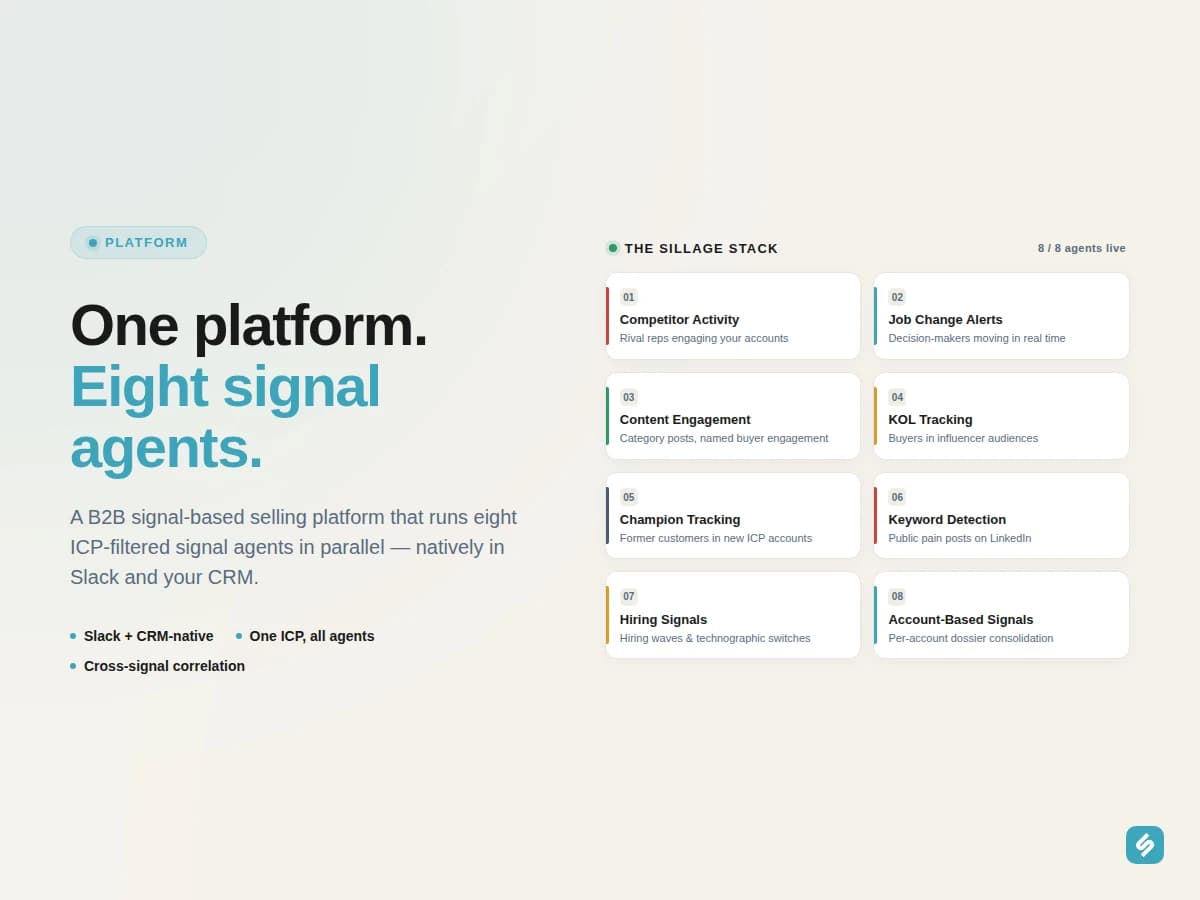
A B2B signal-based selling platform is the operational layer your sales team needs once you accept that cold lists are dead and individual signal tools end up as shelfware. Instead of stitching together five point solutions (one for competitor monitoring, one for job changes, one for keyword detection, one for hiring data, one for influencer audiences), you run all signal categories on a single platform that filters by ICP, enriches with CRM context, and routes alerts inside Slack and the CRM. This page covers what the platform model actually means, why it beats stack-of-points, and how Sillage organises eight specialised signal agents inside one operational layer.
What is a B2B signal-based selling platform?
A signal-based selling platform is the consolidation layer that turns a fragmented intent-data stack into a single source of truth. It does four things that point tools cannot, by definition:
- It runs multiple signal agents in parallel, competitor activity, job changes, content engagement, influencer signals, champion tracking, keyword detection, hiring patterns, account-level research, without forcing reps to log into eight dashboards.
- It applies one ICP filter across all signals, so the same Personas definition (role, seniority, company size, industry, geography) gates every alert from every agent. No agent runs noise; all agents converge on the same target universe.
- It correlates signals across agents on the same account or contact, surfacing the moments where two or three signals stack, which is where the conviction lives.
- It delivers everything natively into Slack and the CRM, eliminating the standalone dashboard that nobody opens after week three.
The difference between a platform and a stack of point tools is not just convenience. It is the difference between a sales team that acts on signals daily and a sales team that pays for signals quarterly without acting on any of them. For the events that actually open a buying window, see pipeline signals; for the full GTM signals typology of what predicts a purchase; and for a head-to-head with the job-change-tracking category, see Sillage vs UserGems.
"We had bought four separate signal tools. The reps used none of them. We replaced everything with the Sillage platform, same agents under one roof, in Slack, and conversion on warm outreach 4x'd in two quarters.", Sillage customer, CRO, B2B SaaS, 250 employees

Cross-signal stack on a target account
Sarah Martin from Doctolib engaged with your competitor on LinkedIn
Why the platform model beats single-purpose signal tools
The single-tool-per-signal model was the right answer in 2021. In 2026 it has three structural failures that no individual vendor can fix.
- Adoption decay. Every standalone signal dashboard your team has to open dies at six months. RevOps quietly cancels the subscription at renewal. The platform model wins because it lives where reps already work, Slack and the CRM, and never asks them to open a new tab.
- Conflicting ICP definitions. When five tools each have their own definition of your target market, every alert queue contains a different flavor of "qualified". The platform model wins because one Persona definition gates every agent.
- No cross-signal correlation. The most valuable signal in B2B is two-or-three-signals-stacked-on-the-same-account. Point tools cannot produce this because they don't know about each other. The platform does it natively.
The pricing math also flips: a platform with eight agents typically costs 30–60 % less than the equivalent stack of point tools, with materially higher adoption.
The eight signal agents that compose the Sillage platform
The platform runs eight specialised signal agents in parallel, each with its own detection logic, each gated by the same ICP filter, each routing into the same Slack channels and CRM. Click into any of them for the full play.
| Agent | Signal detected | Best for |
|---|---|---|
| Competitor's Activity | Rival reps engaging your target accounts on LinkedIn | Pre-RFP interception, race condition detection |
| Job Updates Detection | Decision-makers changing roles in real time | Catching the 30-90 day buying window |
| Content Engagement | Buyers engaging with category content on LinkedIn | Mid-funnel intent detection |
| Influencer Engagement | Buyers engaging with B2B KOLs in your category | Creator-led outbound sourcing |
| Champion Tracking | Former customers landing in new ICP accounts | Trust-based warm re-engagement |
| Keyword Detection | Prospects publicly posting about your category | Named-buyer intent from public posts |
| Job Posting Insights | Hiring patterns: waves, technographics, strategic first hires | Budget allocation signal |
| Account-Based Signals | Funding, leadership, expansion, sentiment per account | Per-account dossier consolidation |
For the broader strategic argument behind why these eight signals are the right starting set, see how signal intelligence is changing prospecting.
How the agents work together, cross-signal correlation
The reason a B2B signal-based selling platform is more than the sum of its agents is correlation. A single signal is interesting. Two signals stacked on the same prospect within a short window is a meeting. Three is a deal forming in front of you.
Three patterns of correlation reliably convert.
Pattern 1, The triple-stack
A past champion lands at an ICP account (Champion Tracking) + a competitor's rep is already engaging that account (Competitor Activity) + a job posting reveals migration off the competitor (Hiring Signals). Three independent agents pointing at the same opportunity. Sillage stacks the three into a single Tier 1 alert.
Pattern 2, The funnel walk
A target account starts engaging with category content (Content Engagement) → a decision-maker posts publicly about a pain (Keyword Detection) → the same account opens a budget through hiring (Hiring Signals). The buyer is walking the funnel in public. Each agent catches one step; the platform sees the whole walk.
Pattern 3, The expansion play
A funding round at a target account (Account-Based Signals) + a new VP RevOps hire (Job Updates) + a hiring wave for SDRs (Hiring Signals). Classic expansion play, classic budget-creation moment, all surfaced as one dossier.
| Correlation pattern | Agents involved | Conviction | Action |
|---|---|---|---|
| Triple-stack | Champion + Competitor + Hiring | Tier 1 | Same-day call by AE |
| Funnel walk | Content + Keyword + Hiring | Tier 1 | Multi-touch sequence over 7 days |
| Expansion play | Account-Based + Jobs + Hiring | Tier 1 | Exec-to-exec outreach within the week |
Native delivery, Slack, Salesforce, HubSpot, and the AI agent API
A platform is only as useful as its distribution surface. Sillage delivers signals through four channels:
- Slack channels, dedicated by team or by tier, with the verbatim signal context and a suggested outreach angle.
- Salesforce, CRM tasks on the right account owner, native field updates, no Zapier or middleware.
- HubSpot, same as Salesforce, native sync, deal stage and last touchpoint included automatically.
- Signal API, for teams running downstream AI agents or custom orchestration, the same per-account signal feed exposed as a structured API. One source of truth for humans and machines. To meet the wider AI-agent community building on top of this kind of feed, see our Agentic GTM Hackathon in Paris (July 2026).
Who benefits most from the platform model
The platform value compounds with sales-team complexity. Three profiles see the highest ROI in the first 90 days.
- CRO and VP Sales of mid-market / enterprise B2B SaaS, the platform fixes the operational debt of running five separate signal vendors. Same agents, half the cost, 4x the adoption.
- RevOps teams running Account-Based Sales, one ICP definition flowing through all signal categories, native CRM round-trip, signal API for downstream automation.
- SDR / AE teams working enterprise accounts, they live in Slack and the CRM. The platform meets them there. Tier-1 alerts arrive with the signal stack already correlated, the persona already matched, the next best action suggested.
For the granular ROI math on a specific signal (champion tracking), see B2B champion tracking software. For the lead-scoring layer that ranks every platform signal, see advanced lead scoring beyond demographics.
Setup and adoption, five minutes per agent
The platform is designed for fast deployment and high adoption. Configuration of the first agent takes about five minutes: connect the CRM, define the Personas, choose the Slack channel for alerts. Each subsequent agent reuses the same Persona definition and the same Slack/CRM routing, incremental setup is near-zero.
Adoption at six months sits north of 90 % on the platform, against industry benchmarks of 30–50 % on standalone signal tools. The reason is simple: Sillage never asks reps to open a separate dashboard. The signals come to them, in Slack, in their CRM queue.
For a competitor view on how Sillage sits among the broader market, see our global comparison of sales intelligence tools 2025 or the AI-angle subset in best AI tools for B2B prospecting.
Frequently asked questions
What is a B2B signal-based selling platform?
A B2B signal-based selling platform is the operational layer that runs multiple signal-detection agents (competitor activity, job changes, content engagement, hiring patterns, keyword detection, champion tracking, influencer signals, account-based research) on a single product, with one shared ICP definition, one CRM round-trip, and one native delivery surface in Slack. It replaces stacks of single-purpose signal tools.
How is it different from a sales engagement platform like Outreach or Salesloft?
A sales engagement platform is for executing sequences (emails, calls, tasks). A signal-based selling platform is for deciding who to engage and when, based on real buying signals. They are complementary, not competing. Sillage feeds the right contacts and the right context into your existing engagement platform.
How is it different from intent data platforms like 6sense or Bombora?
Intent data platforms surface anonymized account-level web research signals. A signal-based selling platform surfaces named-contact and named-account signals from multiple public sources (LinkedIn, job boards, press, regulatory filings, etc.), with per-account aggregation and CRM-native routing. Different signal surfaces, different actionability profile.
Which CRMs does Sillage integrate with?
Native integrations with Salesforce and HubSpot. The platform reads from and writes to your CRM directly, no Zapier, no middleware, no manual exports. Both deal context and account owner are pulled automatically to enrich every alert.
How does the ICP filter work across all agents?
You define Personas once inside Sillage, role, seniority, company size, industry, geography, plus any custom criteria your RevOps team needs. Every detection event from every agent passes through the same Persona gate before generating an alert. The result is a unified target-universe view across all signal categories.
Can the platform feed an AI agent or custom workflow?
Yes. Beyond Slack and CRM distribution, the Sillage Signal API exposes the same per-account aggregated signal feed as a structured endpoint. Custom AI agents, downstream scoring models, and outbound automation tools consume the same source of truth that humans see in Slack.
How long does it take to roll out the platform?
The first signal agent takes about five minutes to configure. Subsequent agents reuse the same Persona definition and Slack/CRM routing, incremental setup is essentially zero. A typical full deployment of all eight agents is done within a single day, with no engineering involvement.
Ready to consolidate your signal stack into one platform that reps actually use? Book a demo and see Sillage's eight signal agents inside Slack and your CRM.
Book a demo
Related plays
- How signal intelligence is changing prospecting, the strategic case for the platform.
- Best AI tools for B2B prospecting, broader market comparison.
- Advanced lead scoring beyond demographics, how the platform feeds your scoring model.
- Turn competitor activity into pipeline, a deep tactical play on one agent.
- Turn past champion job changes into pipeline, a deep tactical play on another agent.
Alternatives and buyer guides
For teams evaluating the platform against a single existing tool:
- Cognism alternative for signal-based selling, when you have the contact data and need the timing.
- Smartlead alternative for signal-based outreach, when you send at scale and need to send on signal.
- Best AI lead generation tools for B2B in 2026, the full stack shortlist.