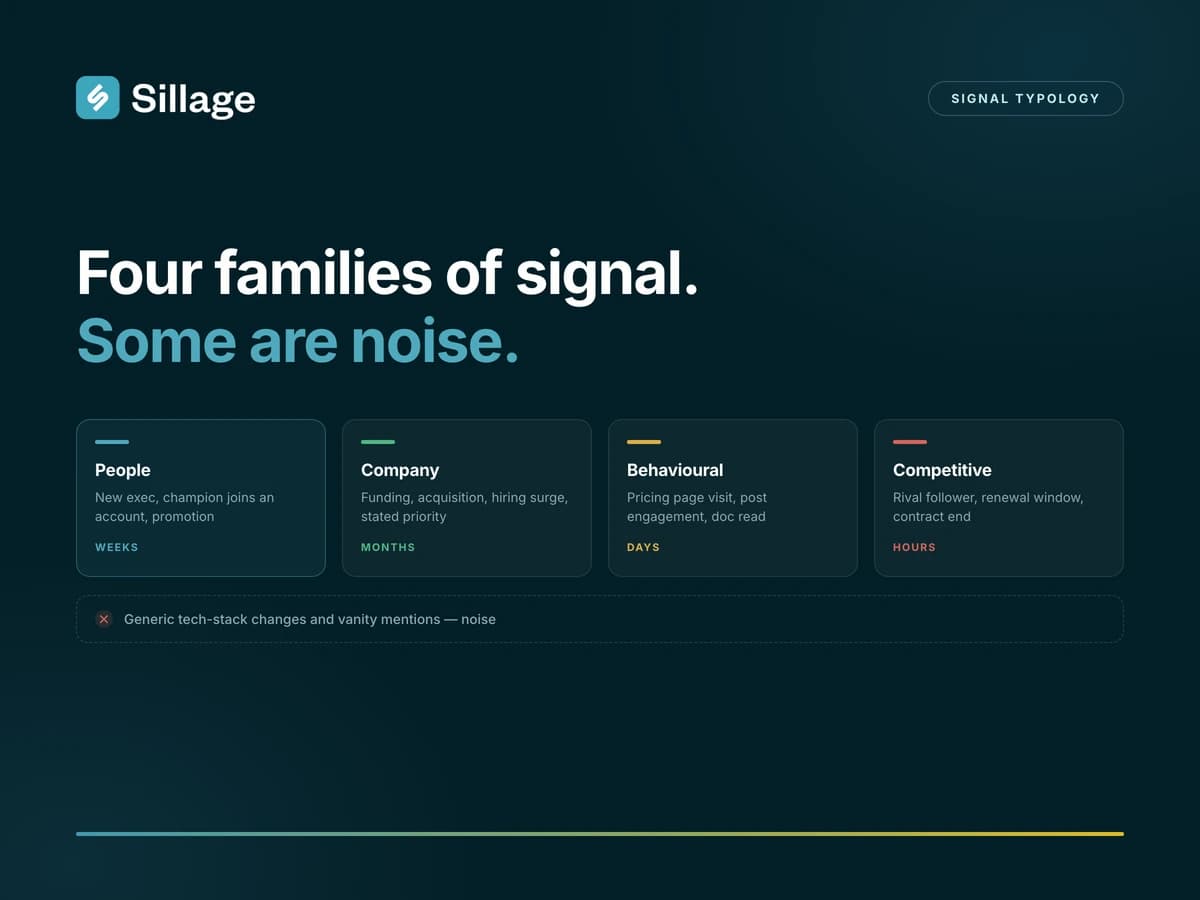
A GTM signal is a public or first-party event on an account that indicates a buying window is opening: a funding round, an executive hire, a tool added to the stack, a named account on the pricing page. The category has been evangelised hard for two years, and the backlash has started, the most-read post on the topic right now argues that most signals are a waste of a rep's time.
That criticism is largely correct, and it is not an argument against signals. It is an argument against tracking fifteen of them. This is the typology, ranked by what each one actually predicts.
The four families
| Family | Examples | What it predicts | Half-life |
|---|---|---|---|
| People | New executive, champion joins a new account, internal promotion | A vendor review, often within the first hundred days | Weeks |
| Company and financial | Funding, acquisition, hiring surge, stated earnings priority | Budget released with a mandate to spend it | Weeks to a quarter |
| Technographic | A tool added or removed from the stack | A gap, or a competitor contract nearing renewal | Months |
| Behavioural | Pricing page visits, engagement with competitor content | An evaluation already under way | Hours to days |
Half-life is the field that decides everything and that most typologies omit. A behavioural signal is worthless after two days. A technographic signal is still actionable a quarter later. Treating them with the same urgency is why teams burn out on their signal feed. For the specific events that reliably open a buying window, see our breakdown of pipeline signals. The hiring surge in the company family is covered in depth under hiring signals.
The signals that are mostly noise
Being specific here is the point. These four are widely sold and rarely predictive.
- Generic website visits. A junior employee on the pricing page has no purchasing power. Without account-level resolution and a named role, this is traffic, not intent.
- Topic-level intent from third-party networks. "This account is researching CRM" covers half your market and dates from last month. It cannot open a conversation because it cannot be referenced.
- Company growth as a standing state. "They are growing" is true of most companies you target, most of the time. A growth event is a signal; growth as a status is a firmographic filter.
- Social engagement without a role filter. An intern liking a competitor's post is not a benchmark in motion. The same action from a stakeholder in the buying group is.
The common failure is the same in all four: the signal cannot be named in a first sentence. If a rep cannot write "I saw that X happened on Tuesday", the signal will not survive contact with the message.
The test: can it be referenced?
Before adding a signal to the feed, run it through three questions. A signal that fails any one of them creates work without creating pipeline.
- Is it an event, with a date? Not a state, not a score.
- Can it be named in the first line of an email without sounding intrusive? A funding round can. A pricing page visit cannot.
- Does it point to a person? A signal on a company that does not tell you who to contact leaves the hardest part undone.
Signal stacking beats signal volume
One signal is a hypothesis. Two independent signals on the same account inside thirty days is a project. A new VP of Sales and twelve open SDR roles is not a coincidence, it is a team being built, with a budget attached.
Rank accounts by the number of independent signals in the window, not by the strength attributed to any single one. This is also the answer to the volume problem: stacking naturally produces a short list a rep can actually work.
Making the feed usable
The operational failure is rarely detection. It is routing. If signals land in a dashboard that requires a login, they are not read. They have to arrive where the rep already is, Slack, and the CRM record, with the account owner tagged and the suggested next step attached.
Book a demo, we run your three most relevant signal agents on one of your top accounts and show you what fires in twenty minutes.Frequently asked questions
How many GTM signals should a team track?
Three at the start. Teams that begin with a full catalogue stop reading the feed within a month, which is the mechanism behind most of the public criticism of the category.
Are GTM signals and intent data the same thing?
No. Intent data is usually a score inferred from third-party browsing. A GTM signal is a named event with a date. The difference matters because only one of the two can be referenced in a message.
Which signal converts best?
Published analyses converge on two: a past champion joining a new account, which you can catch with champion job change tracking, and a hiring surge in the relevant department. Both are people signals, both are public, both point to a named person.
Why do so many teams say signals do not work?
Three causes, in order: too many signals tracked, no half-life applied so stale signals are worked as if fresh, and no routing so nothing is acted on within the window.
Do GTM signals replace an ICP?
They presuppose one. A perfect trigger on an account that cannot buy is a distraction with a good story attached.
Want a feed of three signals your reps will actually work, not fifteen they will ignore? Book a demo and see what fires on your top accounts.
Book a demo