Looking for a Pharow alternative for B2B competitor monitoring usually means one specific thing: you bought a French-market contact database, you got list-building speed, and you are now realizing that you did not buy a competitor monitoring tool. Pharow is excellent at what it is, a contact database with light intent signals. It is not architected for what most growing B2B SaaS teams need next: real-time, named, ICP-filtered competitor activity routed inside Slack and the CRM. This page explains why the gap matters and how teams migrate without losing the Pharow data layer they already paid for. For the underlying play, see Sillage's competitor activity agent.
What Pharow is excellent at, what it is not
Honesty makes shortlists faster. Pharow does several things well, and at a price point that works for the French SMB market. It is a contact database first, with a few firmographic signals layered on top.
Pharow's clear strengths:
- French SMB and mid-market contact coverage, hard to beat in its category
- Quick list-building motion for SDRs working FR-focused outbound
- Simple pricing model, friendly to teams of 5 to 20 reps
Where Pharow stops being the right fit for competitor monitoring:
- No real-time named-contact signals from competitor engagement on LinkedIn
- No ICP filter at the source for monitoring alerts
- No native Slack channel, alerts arrive as exports or Zapier flows
- No cross-signal correlation across multiple buying-intent layers
- No structured signal API for downstream AI agent automation
"Pharow gave us the list. Sillage gave us the next move on the list. The two are not the same thing." — Sillage customer, RevOps Lead, B2B SaaS, 60 employees

Competitor activity on a Pharow-sourced account
Sarah Martin from Doctolib engaged with your competitor on LinkedIn
Why the gap matters for a competitor monitoring motion
Three structural shifts in 2026 explain why a contact database alone, however good, is no longer enough for serious competitor monitoring.
Shift 1, named-contact buying signals are the actionable layer
The cleanest buying signal in B2B in 2026 is not "Acme Corp shows interest in your category". It is "Sarah Martin, VP RevOps at Acme Corp, just followed your competitor's company page and liked their pricing post". Pharow surfaces lists; Sillage surfaces named, dated, public buying gestures.
Shift 2, the rep stays in Slack and the CRM
Reps do not open separate dashboards in 2026. The signal needs to land in the channel they already work in, with the deal context already attached. A Zapier flow that drops a CSV into a folder is operational debt.
Shift 3, AI agents need structured signal input
If your roadmap includes any downstream AI orchestration (auto-prospecting, auto-personalization, auto-routing), the input shape matters. A structured Signal API that exposes per-account, ICP-filtered, dated signals is the dependency. A contact database does not produce that shape.
- Contact list and firmographics
- Light intent signal at account level
- Export to CSV or Zapier
- No ICP filter at source
- No cross-signal correlation
- Pharow keeps the contact layer
- Sillage adds named-contact signals
- Slack + CRM native delivery
- ICP filter at detection
- Cross-signal correlation, all agents
How teams typically migrate from Pharow-only to Pharow + Sillage
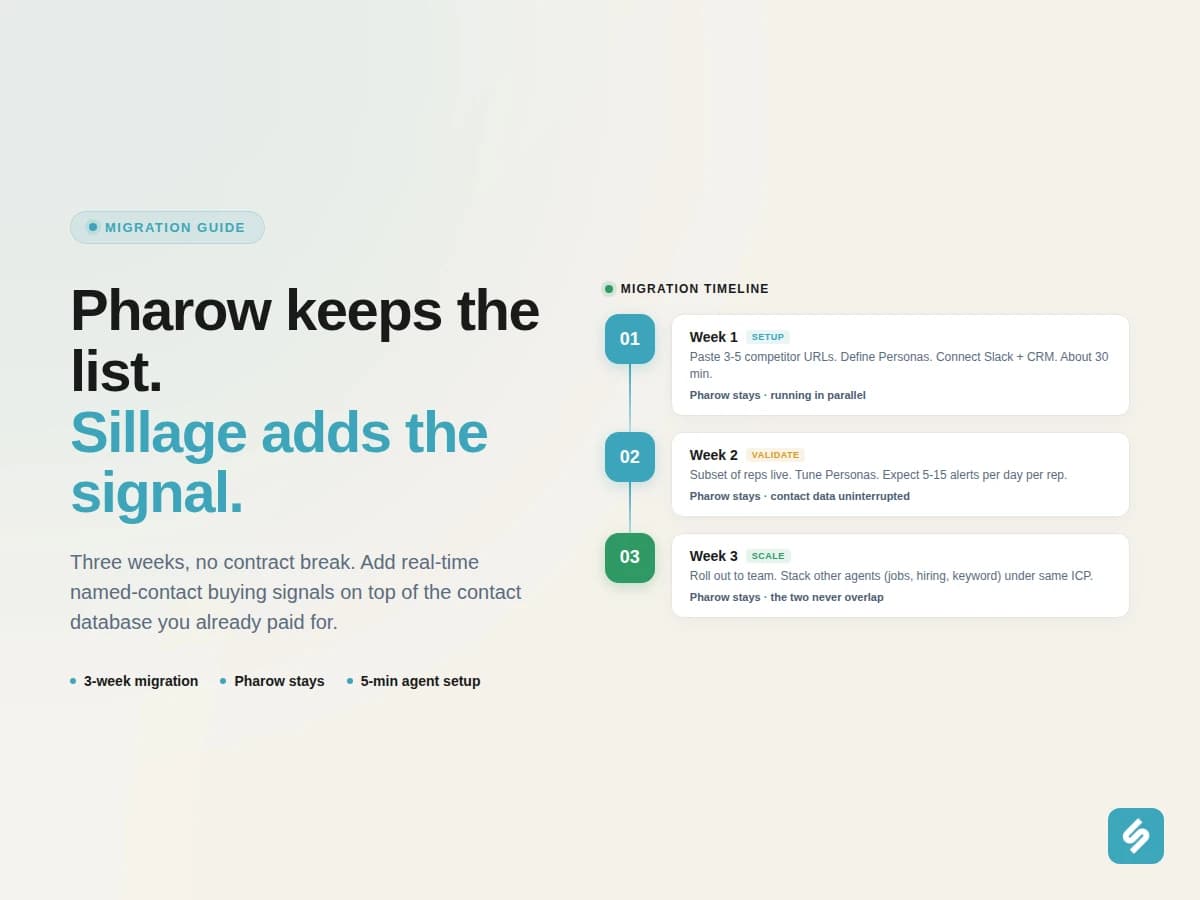
The migration is not a rip-and-replace. Pharow does its job, contact data, and Sillage does its job, signal monitoring. Three phases, three weeks, no contract break.
Phase 1, instrument the competitor list (week 1)
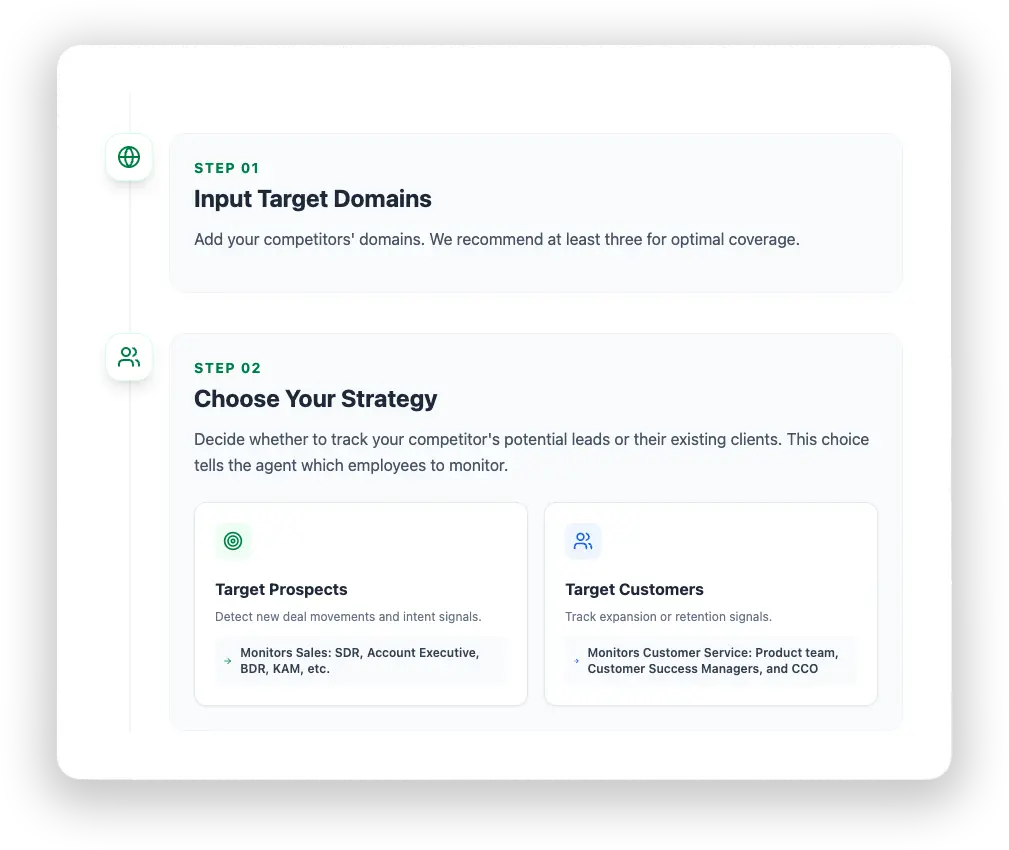
Inside Sillage, set up the Competitor's Activity agent. Paste the 3 to 5 competitor company URLs. Define the Personas using the same definitions your team already uses for Pharow list-building. Connect Slack and the CRM. Total setup: about 30 minutes.
Phase 2, validate the alerts (week 2)
Run alerts for a week with a small subset of reps. Tune Personas if needed. The expected output is 5 to 15 high-conviction alerts per day per rep, each with a verbatim signal, deal context, and a suggested outreach. If the alert volume is wrong, the ICP definition is wrong, not the agent.
Phase 3, roll out to the team and stack agents (week 3)
Roll out to the full sales team. Stack additional agents (job change alerts, hiring signals, keyword detection) under the same ICP definition. Each new agent reuses the existing Slack and CRM routing, incremental setup is essentially zero.
After three weeks, the team has Pharow for contact data and Sillage for real-time named-contact signals. The two never overlap.
What you gain in the first 90 days
Three benchmarks from typical migrations, not vanity metrics.
| Benchmark | Pharow only | Pharow + Sillage |
|---|---|---|
| Named-contact signals per week per rep | 0 (contact lists only) | 30 to 80 |
| Signal-to-meeting conversion | Not measurable, no signal layer | 10 to 20 % of qualified alerts convert to a meeting |
| Adoption rate at 6 months | List-building tool, dependent on SDR habit | 90 %+ on Slack-native delivery |
| Setup time for a new signal type | Not applicable | 5 minutes (reuses existing ICP) |
For a deep head-to-head and full feature comparison
This page covers the migration logic. For the feature-by-feature head-to-head, see Pharow vs Sillage: automate competitor analysis. For the broader market comparison of competitor monitoring tools, see the best B2B LinkedIn competitor monitoring tool shortlist.
Frequently asked questions
Should I cancel Pharow when I add Sillage?
Usually no. Pharow continues to do its job (contact data, firmographics, French SMB coverage) and Sillage adds the signal layer Pharow does not have. The two cover non-overlapping needs. If the contract is up for renewal and budget is tight, the order to consider cutting first is the one that produces the lower ROI for your specific motion.
Does Sillage have the same FR market coverage as Pharow?
For contact data, no, Sillage is not a contact database. For signal coverage on FR-based accounts and decision-makers, yes, the Competitor's Activity agent and the seven other Sillage agents work the same way for FR profiles as for any other geography.
How long does the migration actually take?
Three weeks for a typical mid-market B2B SaaS team. Week 1, agent setup and Persona definition. Week 2, validation with a subset of reps. Week 3, team rollout and stacking of additional agents. No contract break with Pharow.
Can I trial Sillage before committing?
Yes. The standard motion is a 15-minute discovery call, then a 7-day trial with your competitors, your ICP, your Slack channel. Live signals from day one.
Does Sillage integrate natively with Salesforce and HubSpot?
Yes. Signals are enriched with CRM context (deal stage, last touchpoint, account owner) and routed as Slack alerts and CRM tasks natively. No Zapier or middleware required.
What if I have an AI agent in my outbound roadmap?
The Sillage Signal API exposes the structured per-account signal feed for downstream AI orchestration. To see live builds plugging AI agents into this feed, the Agentic GTM Hackathon in Paris (July 2026) is the most concrete reference.
What is the pricing model?
Per-seat platform pricing, one price covers access to all eight signal agents. The pricing model is built so adding a new signal agent does not require a new SaaS subscription.
Ready to add the named-contact signal layer Pharow does not produce? Book a demo and see Sillage running on your competitor list inside Slack and your CRM.
Book a demo
Related plays
The other 3 plays inside the competitor monitoring cluster:
- Track competitor audience and followers on LinkedIn, the audience-focused tactical play.
- Best B2B LinkedIn competitor monitoring tool, the 2026 shortlist.
- Pharow vs Sillage: automate competitor analysis, the head-to-head.
For the broader BOFU view, see the global sales intelligence tools comparison 2025.