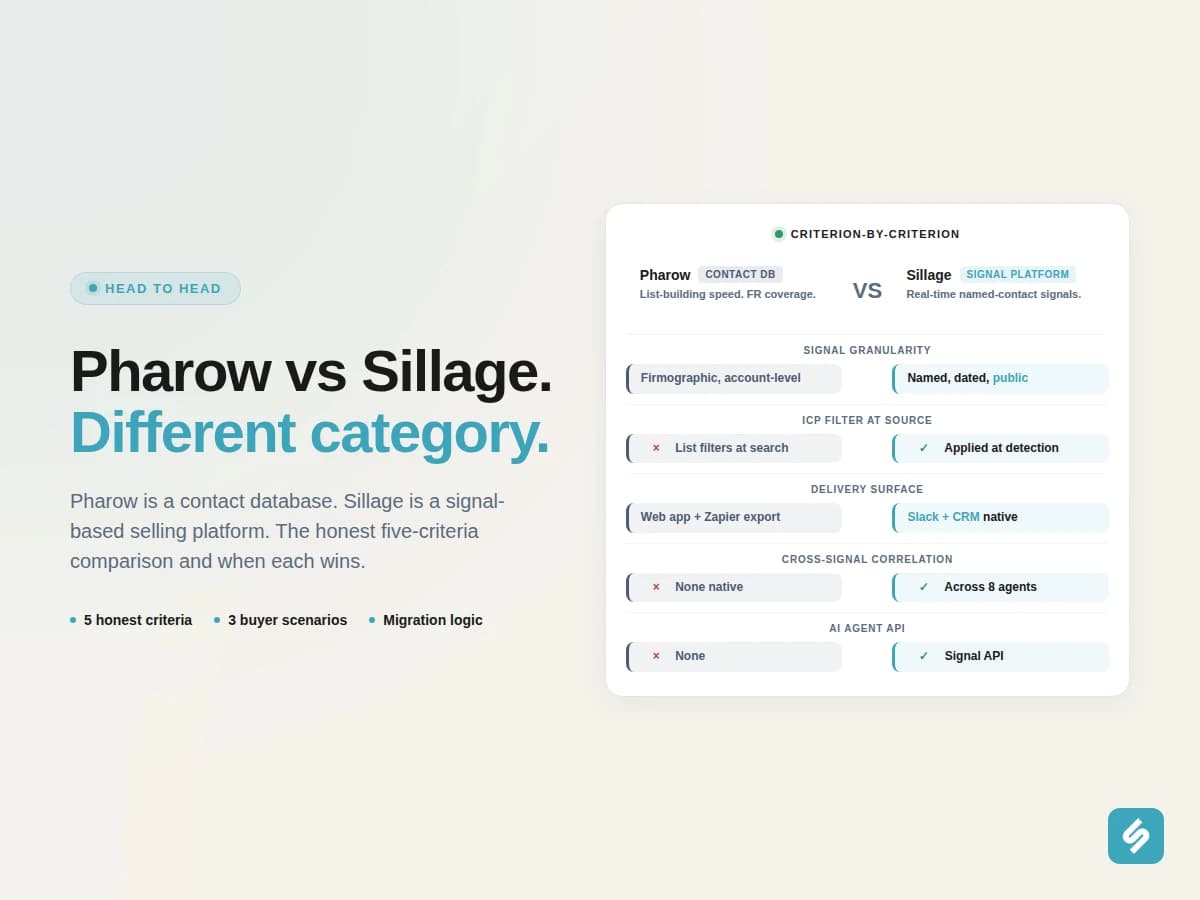
The honest Pharow vs Sillage comparison starts with one fact: these are not competing products. Pharow is a contact database. Sillage is a signal-based selling platform with a dedicated competitor activity agent. The two answer different questions, get adopted by different roles, and live in different parts of the stack. This page maps the differences across five criteria buyers actually care about in 2026. For the platform context behind Sillage's competitor monitoring, see our real-time LinkedIn competitor intelligence deep-dive.
The categorical answer first
Skip the feature lists. Pharow is the right pick when the question is "who could I call?". Sillage is the right pick when the question is "who just did something I can call about?". The first is list-building. The second is real-time named-contact buying signals. Most growing B2B SaaS teams need both, in that order.
| Pharow | Sillage | |
|---|---|---|
| Category | Contact database | Signal-based selling platform |
| Primary input | Firmographic and contact data | Public LinkedIn engagement and job activity per account |
| Primary output | Lists for SDRs to call | Real-time, ICP-filtered alerts inside Slack and the CRM |
| Primary buyer | SDR Manager, Head of Outbound | RevOps, VP Sales, CRO |
| Stack position | Top of funnel sourcing | Mid-to-bottom of funnel signal routing |

Competitor activity detected on a target account
Sarah Martin from Doctolib engaged with your competitor on LinkedIn
The five-criteria head-to-head
| Criterion | Pharow | Sillage |
|---|---|---|
| Signal granularity | Firmographic and contact data, account-level intent partnerships, lists of who might be interested. | Named contact, dated, public LinkedIn events. 8 signal agents (competitor, jobs, content, KOL, champion, keyword, hiring, account-based). |
| ICP filter at the source | List filters at search time, not at alert time. | Persona definition applied at detection. Non-matching events drop silently before reaching reps. |
| Delivery surface | Web app + CSV export + CRM sync via Zapier. | Native Slack + Salesforce + HubSpot. No new tool, no new tab. |
| Cross-signal correlation | None native, lists are independent. | Automatic across all 8 agents. Stacked signals get promoted to tier-1 alerts. |
| AI agent API | None. | Structured Signal API exposing the per-account feed for downstream orchestration. |
| Pricing model | Per-seat, FR SMB-friendly entry point. | Per-seat, platform pricing covering all 8 signal agents. |
| Adoption at 6 months | SDR habit dependent (web app to open). | 90 %+ in Slack-native delivery. |
| Setup time for the first signal type | Account setup + list import, a few hours. | 5 minutes for the first agent. Incremental setup is near-zero. |
When Pharow wins
Three scenarios where Pharow is the right answer, full stop.
- You need French SMB contact density. Pharow's coverage of FR-based mid-market and SMB accounts is genuinely hard to beat at the price point. If your motion is FR-first outbound to SMBs, Pharow is the right contact-data layer.
- Your team is 5 to 15 SDRs doing manual list-building. The Pharow UI is fast and well-designed for that motion. The team gets value on day one.
- You do not need real-time signal alerting. If your outbound motion is volume-based and signals are not part of the play, you do not need Sillage at all yet.
When Sillage wins
Three scenarios where Sillage is the right answer.
- You run Account-Based Sales on a defined account list. ABS motions live or die on signal quality and routing. Sillage was built for this shape of team.
- You need named-contact buying signals routed inside Slack. The Slack-native delivery surface is what unlocks adoption at scale. If reps would have to open a separate tool, the tool fails at 6 months regardless of feature parity.
- You have AI agent automation in your roadmap. The Signal API is the dependency. Contact databases do not produce structured signal feeds.
The two never overlap. The list of who you could call lives in Pharow. The list of who just did something you can call about lives in Sillage.
Migration logic if you already use Pharow
You do not replace Pharow with Sillage, you add Sillage on top. The migration runs in three weeks with no contract break.
- Week 1. Set up the Sillage Competitor's Activity agent with your 3 to 5 competitors. Define Personas using the same ICP your team uses for Pharow list-building. Connect Slack and the CRM.
- Week 2. Validate the alert quality with a subset of reps. Tune Personas if needed. Expected output is 5 to 15 high-conviction alerts per day per rep.
- Week 3. Roll out to the team. Stack additional Sillage agents (job change alerts, hiring signals, keyword detection) under the same ICP. Each new agent reuses the existing routing.
For the deeper migration play, the Pharow alternative for B2B competitor monitoring page covers the phase-by-phase setup, the typical benchmarks at 90 days, and the way Pharow data continues to feed the motion.
Common questions buyers ask in this comparison
Is Sillage a Pharow replacement?
No. Sillage is a signal-based selling platform, not a contact database. Most teams run Pharow for contact data and Sillage for signal routing in parallel. The two answer different questions.
Does Sillage cover the French market the same way Pharow does?
For contact data, no, that is not what Sillage is. For signal coverage on FR accounts and decision-makers, yes, the Competitor's Activity agent and the seven other Sillage agents work identically for FR profiles.
Which is cheaper?
Pharow's entry tier is friendlier for small SDR teams. Sillage's platform pricing is competitive against a stack of point tools (one ICP, one delivery surface, 8 agents under one price), so the comparison flips for mid-market and enterprise teams who would otherwise stitch multiple subscriptions together.
Can both tools coexist in the same Salesforce or HubSpot?
Yes. Sillage syncs natively with both Salesforce and HubSpot. Pharow's CRM sync (via Zapier or native depending on plan) writes contact and account data. The two never write to the same fields, so no conflict.
How does the Slack-native delivery work?
You pick a Slack channel during Sillage setup (typically one per rep team or one per signal tier). Every ICP-matched signal lands in that channel as a Slack message with the verbatim signal context, deal stage from the CRM, last touchpoint, and a suggested outreach. No separate dashboard.
What if my outbound roadmap includes AI agents?
The Sillage Signal API is the structured feed those AI agents consume. The same source of truth that humans see in Slack is exposed via API for downstream orchestration. To see live builds plugging AI agents into this feed, the Agentic GTM Hackathon in Paris (July 2026) is the most concrete reference.
How fast can we get value?
The first Sillage signal agent is configured in about five minutes. The expected output, 5 to 15 high-conviction alerts per day per rep, starts within hours.
Ready to add the named-contact signal layer your contact database does not produce? Book a demo and see Sillage running on your competitor list, inside Slack and your CRM.
Book a demo
Related plays
The other 3 plays inside the competitor monitoring cluster:
- Track competitor audience and followers on LinkedIn, the audience-focused tactical play.
- Best B2B LinkedIn competitor monitoring tool, the 2026 shortlist.
- Pharow alternative for B2B competitor monitoring, the migration guide.
For broader context, the global sales intelligence tools comparison 2025 and the B2B signal-based selling platform deep-dive cover the broader stack.