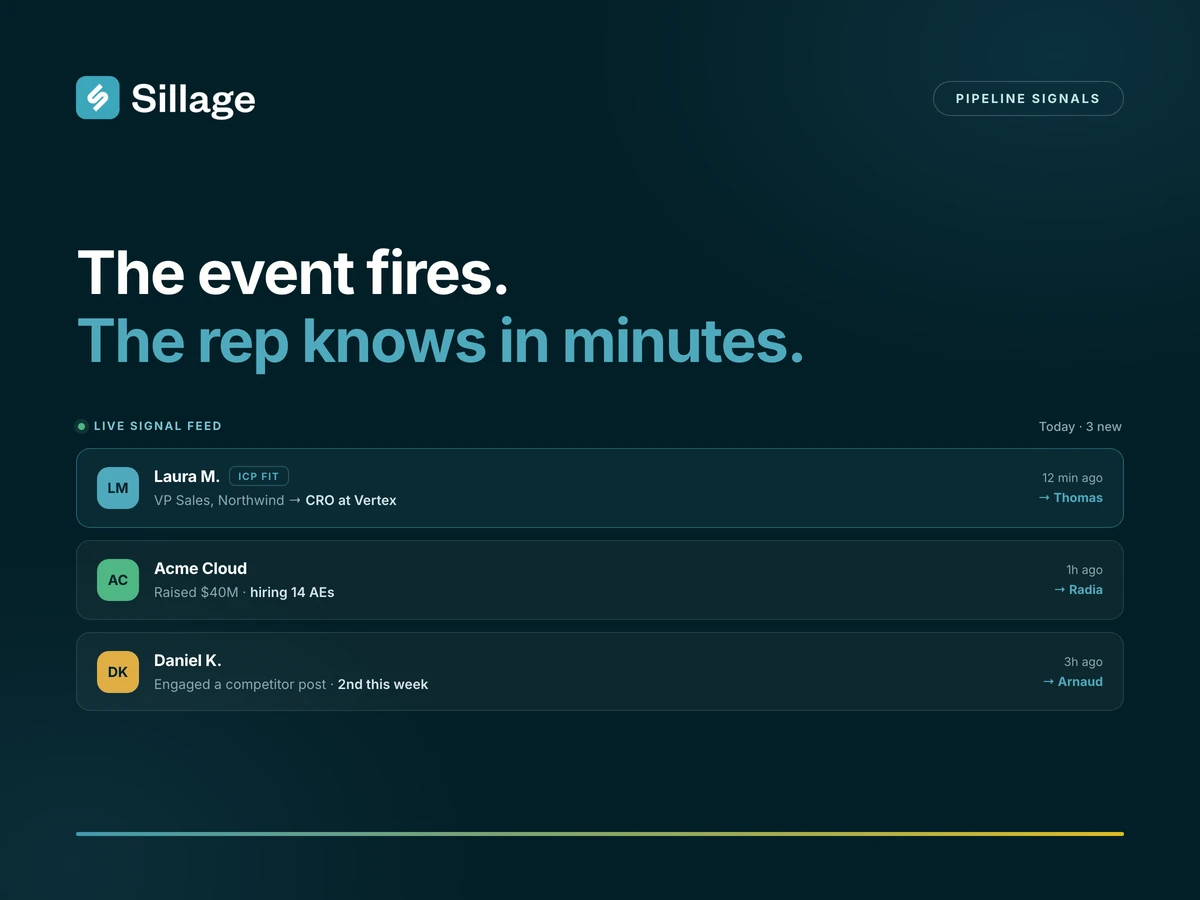
When modern revenue teams look for a reliable methodology to escape the unpredictable nature of traditional outbound sales, they turn to pipeline signals. Relying on static contact lists and blind mass emailing is no longer a sustainable way to scale in a saturated digital landscape.
By integrating the Sillage signal-based selling platform directly into your Go-To-Market operations, your team can automatically detect the precise moments when target accounts enter an active buying cycle. This transforms cold outreach from a disruptive pitch into a timely intervention that accelerates deal velocity.
This guide deconstructs the mechanics of signal-based prospecting: what these triggers are, which examples matter most, and how sales teams convert raw intent data into predictable qualified pipeline.
What are pipeline signals in B2B sales?
A pipeline signal is a measurable event or behavioral trigger indicating that an account is highly likely to purchase in the near future. These are not static data points like company size; they are dynamic, real-time indicators of a shifting business priority or an emerging pain point.
When a company experiences a significant change, rapid growth, an earnings report, a technological migration, its immediate needs evolve. Instead of manufacturing demand, high-performing sellers use these triggers to capture existing demand.
Focusing on account signals lets you prioritise the potential customers who actually have an active budget. Engaging a prospect precisely when a relevant trigger fires dramatically reduces the friction of the early pipeline stages in a complex enterprise sales cycle.
Key examples of high-converting pipeline signals
Not all signals carry the same weight. To build a robust scoring model, differentiate low-intent noise from high-intent indicators. The most effective strategies split triggers into two buckets: internal behavioural signals and external business context.
| Signal category | Trigger example | Intent | Sales action |
|---|---|---|---|
| Inbound, behavioural | Repeat visits to the pricing page in a week | Medium | Enrol in a product-specific nurture sequence |
| Inbound, engagement | Whitepaper download or video watched | Low / medium | Connect on LinkedIn, offer a Q&A |
| Outbound, financial | Series B funding round closed this month | Very high | Direct executive outreach on scalable ROI |
| Outbound, organisational | New VP of Sales or Customer Success hired | High | Multi-threaded outreach to the new decision-maker |
| Outbound, technological | Competitor software installed | High | Competitive displacement campaign |
1. Executive leadership changes
A new C-level executive or VP is almost always tasked with auditing current processes and driving immediate improvements. New executives typically deploy a large share of their initial budget within their first hundred days.
If a target account hires a new Head of Revenue, they are likely re-evaluating their CRM, sequencing tools and data providers. Reaching out to congratulate them is highly effective. This is exactly the play behind champion job change tracking.
2. Funding rounds and earnings reports
A funding announcement or a positive quarterly earnings call is a public declaration of an aggressive growth mandate. If your product helps companies scale efficiently, that window is where your messaging lands.
3. Rapid team expansion and hiring sprees
Monitoring a career page is underused. Thirty new engineering roles means developer tools and project management seats will be needed within the quarter. The signal tells you exactly which department is under pressure. This is the layer covered by hiring signals.
4. Technology stack installations
Knowing a prospect's stack is a competitive advantage. If a prospect installs a direct competitor's product, they have recognised the problem and hold an active budget, the moment to prepare a displacement campaign before renewal.
Book a demo with Sillage to see which external buying signals are firing in your target market right now.Turning buying intent into predictable revenue
Identifying a signal is the first step. Monetising it requires a systematic workflow that turns raw alerts into booked meetings. By the time a rep discovers a funding round organically, five competitors have already sent their pitch. Speed to lead decides the outcome.
The three-step signal execution framework
- Automated detection, a dedicated intelligence platform monitors the web for the triggers that match your ICP.
- Instant enrichment, when a signal fires, the system finds the right decision-makers and verifies their contact details.
- Contextual outreach, the rep references the exact trigger rather than sending a generic pitch.
The PricingHUB case
PricingHUB's SDR team relied on a volume approach with poor response rates. After moving to a signal-driven architecture with Sillage, mapping triggers such as expansion into new international markets, reply rates rose sharply and the number of meetings booked tripled.
Integrating pipeline signals into your CRM and workflows
If intent data lives in a separate dashboard that reps must check manually, adoption fails. The data must live where the team already works: Salesforce, HubSpot, and a dedicated Slack alert channel that tags the account owner the moment a tier-one account moves. Consolidating every event per account is the job of an account-based signals layer.
Signal-based selling and ABM
ABM focuses deep resources on a static list of high-value targets regardless of timing. Signal-based selling prioritises timing above all, it is the radar for your ABM strategy, telling you which of your hundred target accounts has an active pain point today.
Frequently asked questions
What is the difference between inbound leads and pipeline signals?
Inbound leads have explicitly engaged with your brand. Pipeline signals are external business events indicating a need, even before the account has visited your site.
How do pipeline signals shorten the sales cycle?
Engaging immediately after a trigger aligns your outreach with active budget discussions and bypasses the educational phase.
Are website visits strong pipeline signals?
They can be, but they are noisy. A junior employee browsing pricing has no purchasing power. An executive hire or a funding round is a far stronger indicator.
Can small startups benefit from signal-based selling?
Yes. With limited SDR time, focusing on high-intent signals ensures every outbound hour is spent where conversion is most likely.
How do I stop reps missing critical alerts?
Full CRM and Slack integration. Never force a rep to log into a separate platform to check for signals.
Ready to act on buying windows the moment they open? Book a demo and see which pipeline signals are firing across your target accounts right now.
Book a demo