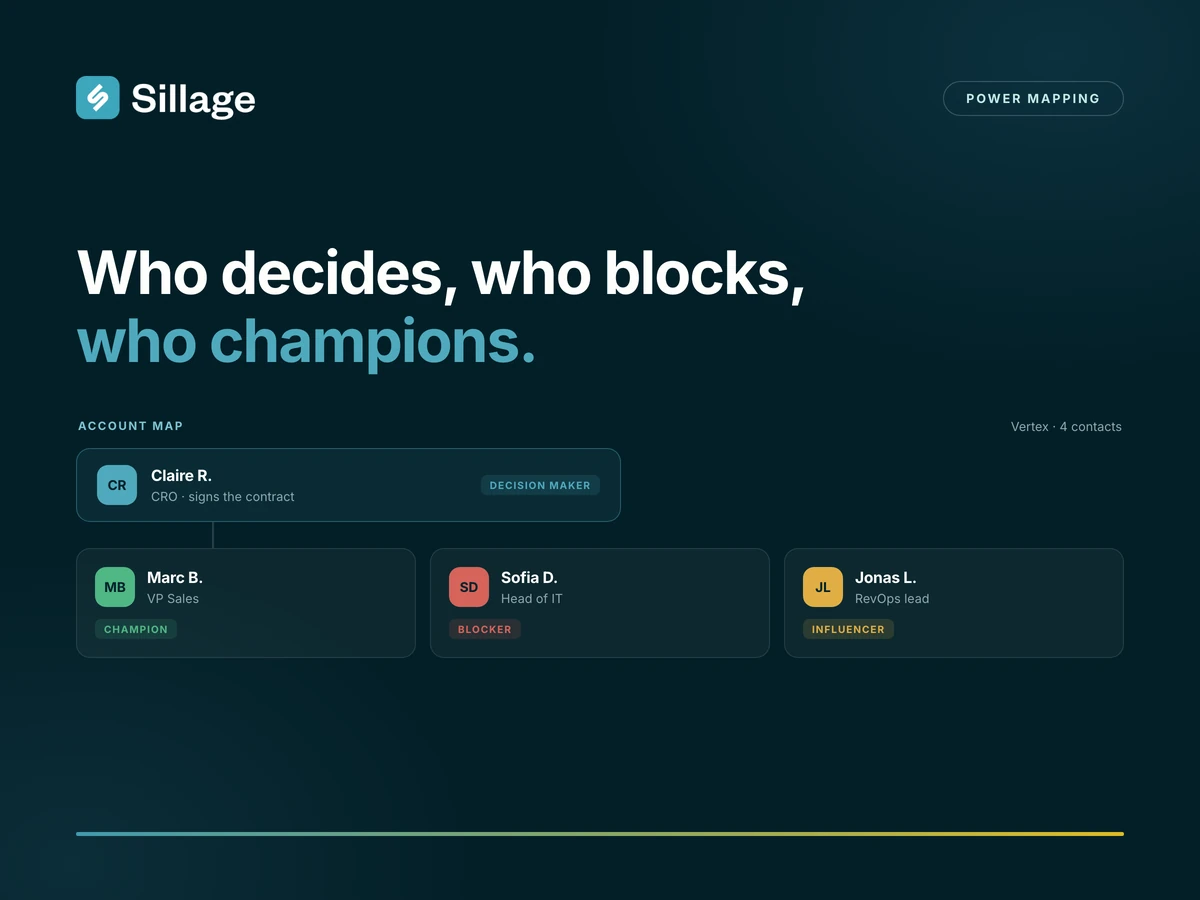
A power map is a chart of the people inside a target account, showing who holds decision authority, who influences it, and how they relate to each other. In enterprise sales it answers one question: if this deal stalls, who can unstick it, and who is quietly stopping it.
Most accounts are lost not because the product failed the evaluation, but because the deal was single-threaded, one contact, one opinion, no visibility on the rest of the buying group. Enterprise deals now involve six to ten stakeholders. Mapping them is not an exercise in office politics; it is deal hygiene.
What a power map contains
A usable power map holds four things per person: their formal role, their influence on the decision, their stance toward you, and who they listen to. Anything beyond that is decoration.
| Status | What it means | What you do |
|---|---|---|
| Decision maker | Signs, or can veto the signature | Get a direct conversation before the shortlist closes |
| Champion | Wants the change and will argue for it internally | Arm them: business case, internal deck, objection answers |
| Blocker | Loses something if you win, budget, control, a vendor relationship | Neutralise, do not convince. Find who outranks them. |
| Do not contact | Burned, hostile, or off-limits for a reason you know | Route around, and note why in the CRM |
The fifth field is the one teams skip: who reports to whom, and who talks to whom outside the org chart. Influence rarely follows the hierarchy. A senior engineer with ten years of tenure often carries more weight on a technical purchase than the VP who signs.
How to build one in four steps
1. List the buying group, not the contacts you have
Start from the decision, not from your CRM. For a purchase of this type, which functions are always involved? Finance, security, the end-user team, the executive sponsor. Write them down as empty slots first. The gaps you cannot fill are the real output of this step.
2. Assign influence, not seniority
Rank each person by how much they can move the decision, on a scale of three: can decide, can influence, can only inform. A director who owns the budget line outranks a VP who does not.
3. Assign stance
Champion, neutral, blocker. Be honest, a contact who answers your emails politely and never introduces you to anyone else is neutral at best. A champion is someone who has spent internal credit on you.
4. Draw the lines
Reporting lines in one style, informal influence in another. The map is finished when you can answer: if my champion leaves tomorrow, who else knows why this project matters?
That last question is not hypothetical. Champion turnover is the most common cause of a stalled enterprise deal, and it is also a signal you can track through champion job change tracking.
Keeping the map alive
A power map drawn once during discovery is out of date within a quarter. People are promoted, leave, join. The map has to update itself from the same events your prospecting watches: leadership changes, internal moves, new hires in the buying group, the kind of pipeline signals that open a buying window.
This is where mapping stops being a slide and becomes an operational asset. Sillage builds the power map of each key account, finds every subsidiary attached to it, and pushes both back into Salesforce or HubSpot. When a stakeholder changes role, the map changes with them and the account owner is alerted in Slack.
| Event on the account | What it changes on the map | Window to act |
|---|---|---|
| A champion leaves | Champion slot empties, deal at risk | Same week |
| A past customer joins the account | New warm entry point | Within 10 days |
| A new executive is hired in the buying group | New decision maker, budget review likely | First 100 days |
| A competitor's rep engages a stakeholder | A blocker may be forming | Within 48 hours |
Power mapping and account-based selling
Account-based selling decides which accounts deserve deep resources. Power mapping decides where those resources go inside the account. They are complementary: a target list without a map produces polite conversations with people who cannot buy. Feeding the map from an account-based signals layer is what keeps it current.
Combine them with signal detection and you get sequencing: the account list tells you where, the map tells you who, the signals tell you when.
Book a demo, we map subsidiaries, stakeholders and live signals on one of your top accounts, in twenty minutes.Frequently asked questions
How many people belong on a power map?
In enterprise deals, six to ten. Fewer than four usually means the buying group is incomplete rather than small.
What is the difference between a power map and an org chart?
An org chart shows reporting lines. A power map shows influence and stance, which frequently contradict the org chart.
When should the map be built?
During discovery, before the first proposal. Building it after a stall means rebuilding trust at the same time as the map.
How do you identify a blocker?
Look for who loses something if you win: a budget line, control of a system, a vendor relationship they chose. Blockers rarely announce themselves.
Can a power map be maintained automatically?
The structure can. Role changes, departures and new hires inside the buying group are public events and can update the map without manual research. The stance column stays human.
Want the power map of a real account, subsidiaries and live signals included? Book a demo and we will build one on a top account in twenty minutes.
Book a demo