Turning signals into action
When a competitor's sales team engages with one of your ICP accounts on LinkedIn, when a lead changes jobs, or when your brand is mentioned through B2B social conversations, these are all signals. But signals alone aren't enough. The real impact comes when they're contextualized, prioritized, and integrated into your workflow. That's where platforms like Sillage make the difference.
The events that open these buying windows are what we call pipeline signals, and not all of them are worth a rep's time, our typology of GTM signals separates the ones that predict a purchase from the ones that are noise.
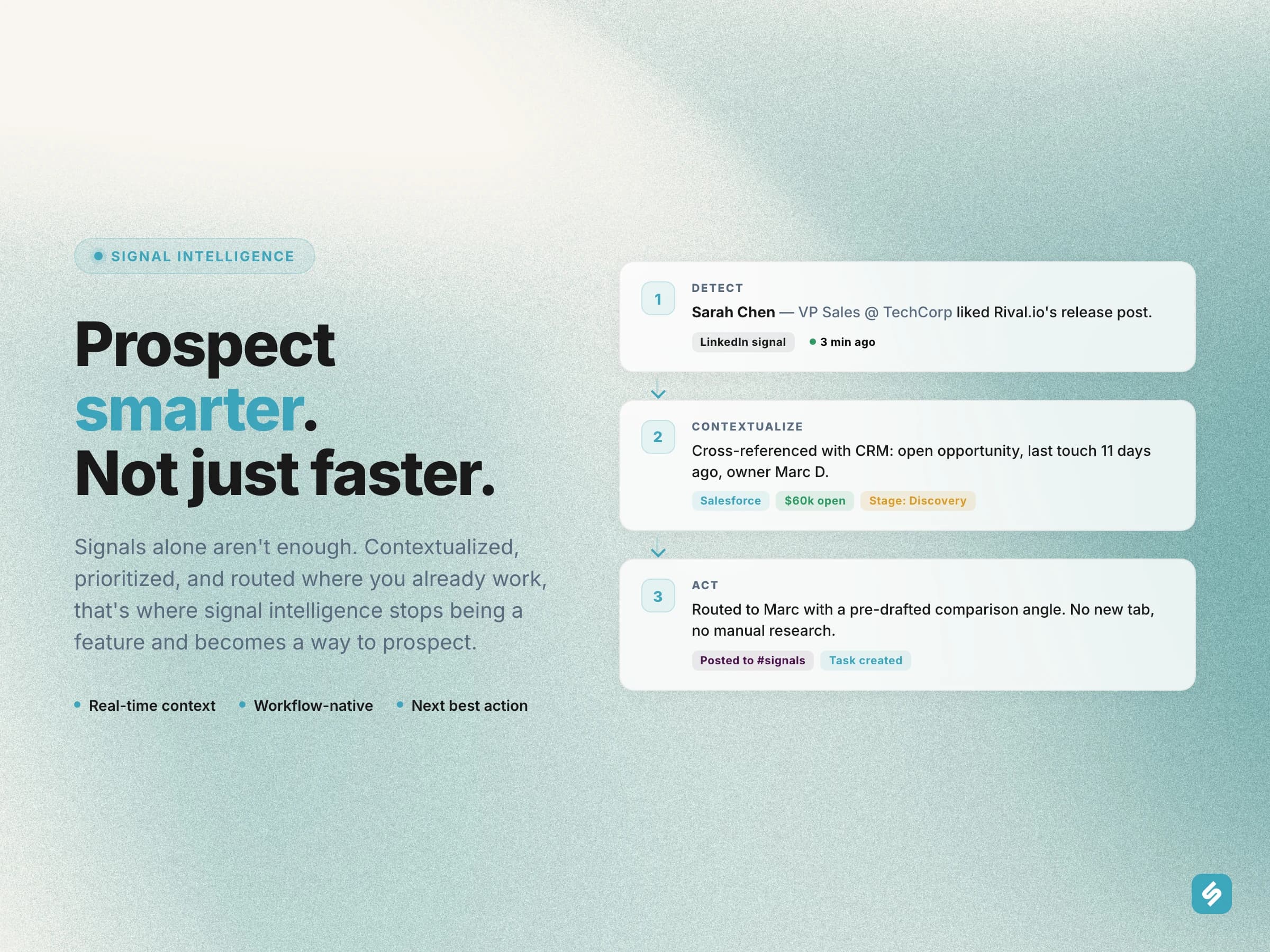
Imagine receiving a Slack notification when a competitor interacts with one of your top ICP accounts on LinkedIn. Not just any notification, but one that includes context: the account's current stage in your pipeline, recent interactions, and suggested next steps.

The goal? Go smarter, not just faster
The goal is not just to go faster, but to go smarter. Traditional prospecting relies on static lists and periodic research. Signal intelligence transforms this into a dynamic, real-time process where opportunities are identified and prioritized automatically.
Consider this scenario: your prospect just liked a competitor's post about a new feature. Within minutes, you receive a notification with:
- The prospect's current relationship with your company
- Recent touchpoints and engagement history
- Suggested talking points based on the competitor's feature
- Pre-drafted email templates tailored to the situation
Beyond competitor activity, the same logic applies to former champions landing in new accounts, prospects surfacing through a LinkedIn intent data tool when they publicly post about pain points, or buyers engaging with B2B creators in your category. Each is a buying signal that compounds when stacked.

Competitor engagement detected
Sarah Chen from TechCorp Inc engaged with your competitor on LinkedIn
This isn't science fiction - it's the current state of intelligent prospecting. The technology exists, the data is available, and forward-thinking sales teams are already gaining competitive advantages through signal intelligence.
Integration is everything
But here's what most people miss: the power isn't in the signals themselves, but in how they integrate with your existing workflow. The best signal intelligence platforms don't ask you to change how you work - they enhance what you're already doing.
Whether you live in Salesforce, HubSpot, or Slack, intelligent signals should meet you where you are. The friction between signal detection and action taking should be eliminated entirely. The same is true of knowing who decides inside an account: the map is only useful when it updates itself from the signals you already track.

Final thoughts
Signal intelligence isn't just a nice-to-have anymore - it's becoming table stakes for competitive B2B sales. The teams that adopt these tools early will build advantages that compound over time.
The question isn't whether signal intelligence will transform prospecting. It already has. The question is whether your team will be among the early adopters or play catch-up later.
What signals are you missing today that could be tomorrow's biggest opportunities?
If you want to see how the AI-agent community is building on top of this signal foundation, join us at the Agentic GTM Hackathon in Paris (July 2026).
For a comparison of the platforms that combine these signals in 2026, see our overview of the best AI tools for B2B prospecting. For the broader buyer's-guide-style comparison of the eight major sales intelligence platforms, see the global comparison of sales intelligence tools 2025. For the platform-level view of the eight signal agents that operationalize this strategy, see our page on the B2B signal-based selling platform. For a deeper look at how lead scoring evolves once you have signal data, read advanced lead scoring beyond demographics. For the public-job-posting layer of the stack, see B2B hiring signals software. And for the consolidation layer that rolls every signal up into one dossier per target account, see our account-based signals tool. This signal-first approach is also what earned Sillage a place in Station F's Future 40.