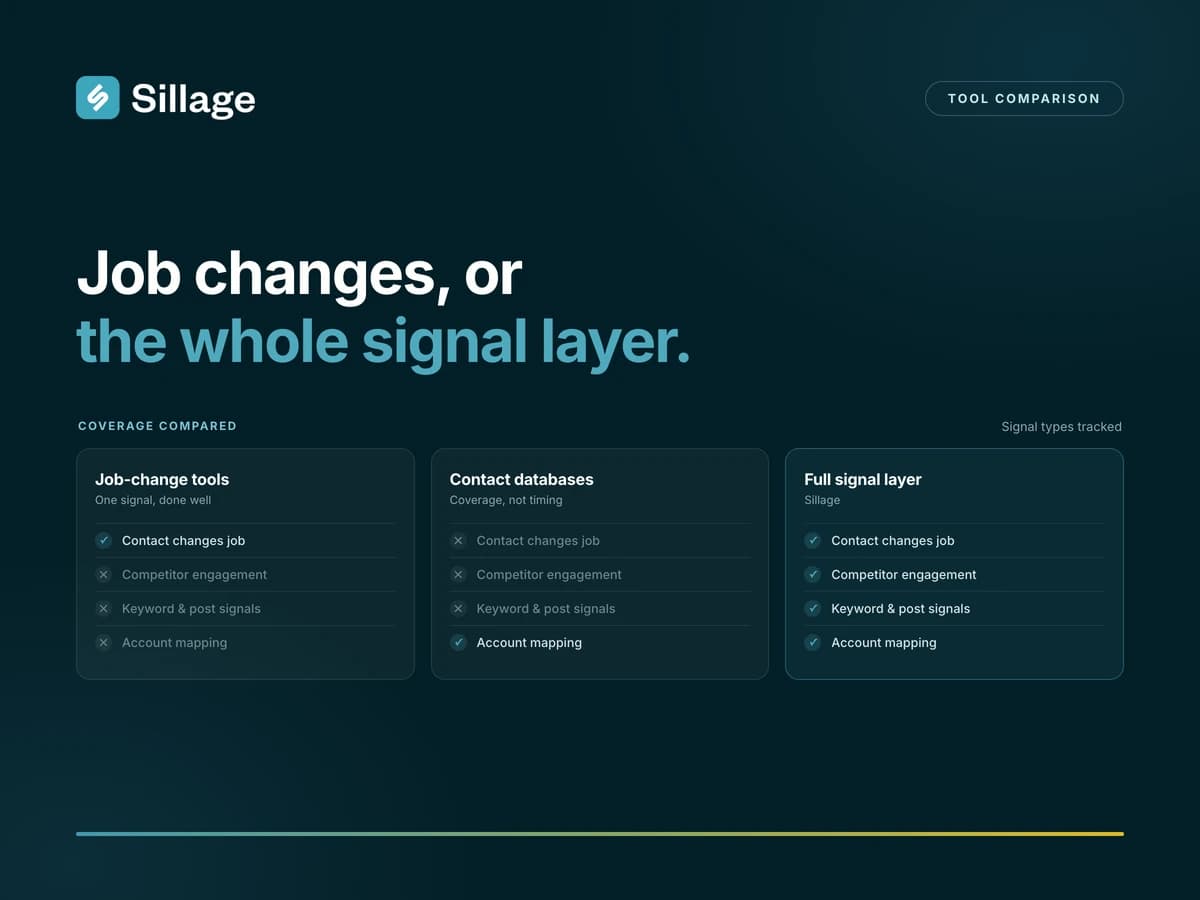
UserGems built the category of job-change tracking: it watches your CRM contacts, tells you when one of them joins a new company, and turns that into a warm entry point. It works, it is well established, and the two most common reasons teams look elsewhere are scope and price.
We build Sillage, which competes in part of this space. So read the next section first: it is the part where we say when we are not the right answer.
When Sillage is not the right choice
- You only want job-change tracking, nothing else. If a single signal is all you need, a specialist is simpler and cheaper. Champify is the closest scope match to UserGems and is built for exactly that.
- Your motion is high-volume SMB outbound. Sillage is built for enterprise accounts with multiple stakeholders. If you work a list of ten thousand small accounts, a database and a sequencer will serve you better.
- You need a contact database. We are a signal layer, not a data provider. If your first problem is "I have no contacts", start with a database vendor.
What each alternative actually covers
| Tool | Core scope | Fits |
|---|---|---|
| UserGems | Job changes on CRM contacts, buyer moves | Teams with a large existing CRM and a past-customer base |
| Champify | Job changes, closest direct scope match | Teams that want the one signal, cheaply |
| ZoomInfo | Contact database first, signals attached | Teams whose primary gap is data coverage |
| Common Room | Community and social signals | Product-led and community-led motions |
| Clay | Enrichment and orchestration, build-your-own signals | Teams with a RevOps engineer to build and maintain it |
| Amplemarket, Apollo | Database plus sequencing plus signals | Teams that want one tool for the whole outbound motion |
| Sillage | Multiple signal agents, power map, subsidiary mapping, Slack and CRM native | Enterprise sales with multi-stakeholder accounts |
The three questions that decide it
1. Is your problem one signal, or several?
Job change tracking is one signal. If your deals also stall on competitor engagement, hiring waves, or stakeholder churn, a single-signal tool will leave you assembling three subscriptions. That consolidation is the argument for a signal-based selling platform.
2. Do you sell to accounts or to individuals?
Enterprise accounts have subsidiaries and six to ten stakeholders. If your problem is "who else is in this deal", you need account resolution and power mapping, not a contact alert.
3. Where will your reps actually see it?
This decides adoption more than feature lists do. A tool that requires a separate login will be checked for two weeks. Ask every vendor what lands in Slack and what lands on the CRM record.
Sillage compared with UserGems
| UserGems | Sillage | |
|---|---|---|
| Primary signal | Job changes on known contacts | Eight signal agents, including job changes |
| Account view | Contact-level | Account-level, with subsidiaries and power map |
| Delivery | CRM, email digests | Slack and CRM native, plus an API for AI agents |
| Built for | Teams with a large past-customer base | Enterprise sales with multi-stakeholder accounts |
| Not for | Teams wanting multi-signal coverage | Single-signal needs, high-volume SMB |
The specific play UserGems pioneered, catching a known contact when they move, is covered on its own under champion job change tracking.
Book a demo, we run the comparison on one of your real accounts and show you what each approach surfaces.Frequently asked questions
What is the closest direct alternative to UserGems?
Champify, on scope. It tracks the same primary signal with a similar approach and is generally positioned lower on price.
Is there a free UserGems alternative?
Not at equivalent coverage. Free tiers in this category cap the number of tracked contacts low enough that the signal stops being useful. Manual LinkedIn monitoring is the real free option, and it costs rep hours.
How much does UserGems cost?
They do not publish pricing publicly, which is why the question appears in People Also Ask. Ask for a quote scoped to your number of tracked contacts and seats.
Can these tools be combined?
Yes, and many teams do, a database vendor plus a signal layer. The combination to avoid is two signal tools with overlapping coverage, which produces duplicate alerts and kills trust in the feed.
What should be tested during a trial?
One thing: on your ten most important accounts, how many signals fire in two weeks, and how many were actionable. Feature comparisons do not survive that test.
Want to know which approach surfaces more on your real accounts? Book a demo and we will run the comparison live.
Book a demo